
Traits

Long Tail (Uncommon)
A long, thick tail that can be much longer than the ottagi’s body.
How to apply this trait:
- This tail should be noticeably longer than a standard tail and can be up to 150% of the body's length.
- The tail's shape should be thick at the base and gradually taper to a point, unless combined with another tail type.

Bushy Tail (Uncommon)
A fluffy tail, much like a fox or raccoon.
How to apply this trait:
- The tail should have a significant amount of fluff, appearing thick and full.
- The tail should be between 75% and 100% the length of the ottagi's body, unless combined with long tail.

Paddle tail (Uncommon)
A flatter, wider tail akin to a manatee or platypus.
How to apply this trait:
- The tail should be wide and flattened, designed for powerful propulsion through the water.
- The tail should be between 75% and 100% the length of the ottagi's body, unless combined with long tail.

Short Tail (Rare)
A noticeably shorter tail than the standard ottagi tail.
How to apply this trait:
- The tail should be present and between 25% and 50% of the ottagi's body length.
- The tail should not appear as a nub or bobtail.
- The tail's shape should be thick at the base and gradually taper to a point unless combined with another tail type.
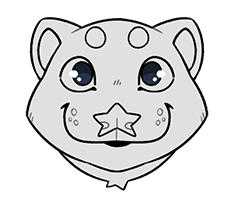
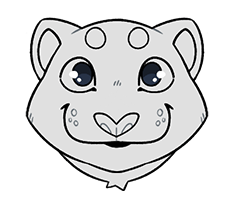
Heart Nose (Uncommon)
A cute nosepad in the shape of a heart.
How to apply this trait:
- The nosepad should be clearly heart-shaped.
- The nose should be prominent and proportional to the ottagi's face.
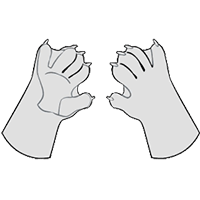
Short Claws (Common)
Short, retractable claws that are common for most ottagi.
How to apply this trait:
- The claws should be short and subtle, not protruding noticeably from the paws when retracted.
- This trait applies to all claws on both the hands and feet.
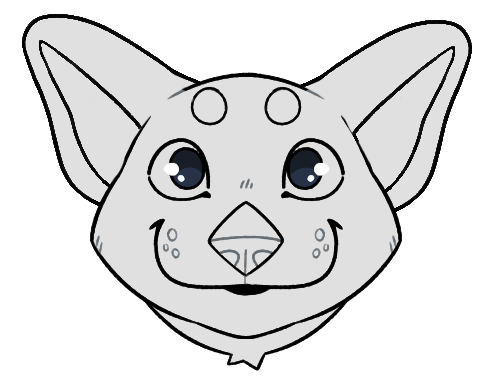
Large Ears (Rare)
Ears that are noticeably larger than the standard.
How to apply this trait:
- These ears can be up to 100% the size of the ottagi's head!
- The ears should be depicted as larger than 25% the size of the head.
- To make them fold or lop, you must also apply folded ears.

Thick Tail (Uncommon)
A thicker tail with a fatty deposit around the midsection, akin to the tail of a leopard gecko.
How to apply this trait:
- The tail should be noticeably thicker and more robust than a standard tail.
- The tail should be between 75% and 100% the length of the ottagi's body, unless combined with long tail.

Whip Tail (Rare)
A tail that is noticeably thinner than a standard ottagi tail, similar to that of a rat or cat.
How to apply this trait:
- The tail should be thin from the base to the tip, lacking the thicker, tapered shape of a standard tail.
- The tail should be between 75% and 100% the length of the ottagi's body, unless combined with long tail.

Ornate Whiskers (Rare)
Ornate whiskers are elaborate facial protrusions that serve as both potent sensory organs and striking status symbols for ottagi, allowing them to feel even the slightest fluctuations in the surrounding mana currents.
How to apply this trait:
- You may have up to 8 individual whiskers - they do not have to be in pairs and can be arranged asymetrically anywhere on the head.
- There are no length limits - they can trail far past the head and drape down the body.
- There is no limit on branching - the whiskers can create intricate antler-like structures, lace-like webs, or appear leafy.
- While they are commonly fleshy, they may also appear hair-like or silky like ribbons. They can also have multiple textures, be tufted, or be segmented.
- The whiskers can also be adorned with jewlery, beads, ribbons, or bells, etc.
Cerata (Rare)
Cerata are specialized, fleshy protrusions similar to those found on nudibranchs (sea slugs). They are highly sensitive and allow an ottagi to detect and absorb mana.
How to apply this trait:
- Cerata are typically found in rows or clusters along the back, neck, tail, or outer edges of the limbs. There's no limit to the number of cerata.
- Cerata should appear soft and fleshy. They can be finger-like, club-shaped, or leaf-like in form, and are smallish or medium-sized.
- The tips may be rounded or featured as simple bulbs, but should not branch or appear jagged.
- The tips may be slightly translucent.